CO-OPS GIS Data Portal
Portal for accessing CO-OPS geospatial data, services, products and applications. For inquiries, please contact tide.predictions@noaa.gov
CO-OPS Stations Data
Map service, Feature service, JSON, SOAP, WMS, WFS
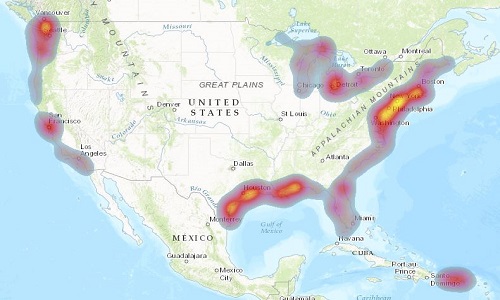
Geospatial data service providing observations collected from CO-OPS oceanographic, meteorological & water levels stations across the US and its territories. The service is updated daily and comprises ten layers: active & historical water levels, active & historical currents, meteorological, conductivity, water temperature, airgap, tsunami water levels and visibility.

CO-OPS Products Data
Map service, Feature service, JSON, SOAP, WMS, WFS
CO-OPS Products service offers geospatial data derived from oceanographic & meteorological observations. The data service is updated daily and includes eight layers: datums, benchmarks, published benchmarks, sea level trends, water level constituents, and extreme water levels, as well as currents and water levels predictions layers.

CO-OPS OFS Models
Map service, Feature service, JSON, SOAP, WMS, WFS
The Operational Forecast System (OFS) GIS service provides polygon data that serves as a spatial representation of the current coverage of OFS models across the US & its territories. This national network of Operational Nowcast & Forecast Hydrodynamic Model Systems offer operational nowcast and 48-hour forecast guidance for various parameters including wind, water levels, currents, salinity, and water temperature.

CO-OPS High Tide Flooding Data
Feature layer, Feature service, JSON
Spatial data for a subset of CO-OPS data and products are available as Hosted layers on Esri's ArcGIS Online. Please refer to the specific layer description for more information or visit CO-OPS High Tide Flooding resource.

CO-OPS Latest Water Level Observations
Web App, WMS, Tabular
CO-OPS tracks water levels across more than 200 tidal and non-tidal observation stations located throughout the coastal United States, its territories, and the Great Lakes, delivering real-time data every 6 minutes. Published on ERMA - NOAA's Environmental Response Management Application® web-based GIS platform, this data layer (metadata) is configured to display the latest water level observations updated every 15 minutes (at :00, :15, :30, and :45).

PORTS
Web map, Feature layer, Feature service, JSON, Shapefile
NOAA's Physical Oceanographic Real-Time System (PORTS) collects & disseminates water levels, oceanographic & meteorological observations. The PORTS Locations dataset presents the geographic distribution of the 43 active PORTS facilities across the United States. The PORTS Stations is a geospatial dataset for 361 observation stations currently active within PORTS. (shapefiles, updated September 2026).

NWLON Coverage and Gaps
Web maps, Shapefiles, Dashboards
Geospatial data for NWLON coverage & gaps for the United States & its territories. Please refer NOAA Technical Memorandum NOS CO-OPS 048. The NWLON Prioritization data offer spatial data layers used for CO-OPS NWLON coverage & gap prioritization studies. (shapefiles, updated June 2023).

CO-OPS Tidal Zones
Web maps, Shapefiles
CO-OPS spatial data representation of tidal zoning with discrete polygons. Zoned tides are constructed relative to a tidal datum by applying time & range correctors to observed water level data from a tide station. (shapefile, updated March 2025).

Alaska VDatum Gaging Overview, ALGO
Web Apps
CO-OPS Alaska VDatum Gaging Overview (ALGO) is a web application designed to support the prioritization of potential tide gage sites, facilitate installation planning, and track ongoing gaging efforts. It also provides multiple contextual data layers to aid in evaluating and prioritizing candidate gage locations.

VDatum Transformation Coverage, VTraC
Web Apps
CO-OPS VDatum Transformation Coverage Tool (VTraC) is a web application designed to delineate the precise spatial extents of VDatum GTX marine grids in relation to valid and invalid transformation polygons, indicating where accurate geodetic and tidal transformations are permissible.
CO-OPS StoryMaps
A catalog of StoryMaps created by CO-OPS and affiliates. https://tidesandcurrents.noaa.gov/


